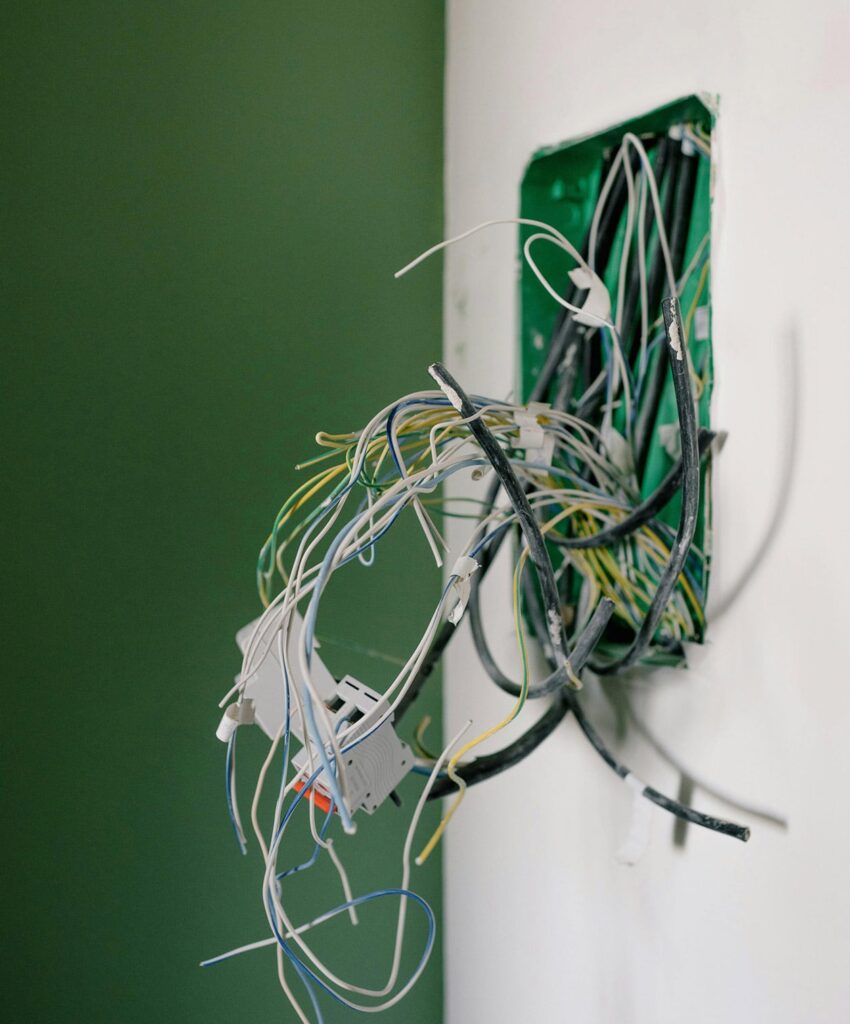
What the Wire Colours Mean
Brown Wires: The “Hot” Wires
Blue is the neutral wire. It completes the circuit by carrying current back to the consumer unit. While it’s not considered “live” in the same way as brown, it can still carry dangerous voltage if there’s a fault — so treat it with the same caution.
Green, Bare Copper, or Green-Yellow Wires: Earth Wires
When to Call an Electrician
Quick Reference
Blue = Neutral
Green/Yellow = Earth
Old colours (pre-2006): Red = Live, Black = Neutral, Green = Earth
If you’re unsure about any wiring in your home, give us a call on 07562334243.
Why Wire Colours Changed in 2004
The UK adopted harmonised European cable colours in March 2004. The transition period ran to 31 March 2006. If your property has wiring older than 2006, you may find a mixture of the old and new colour schemes in the same consumer unit — a common source of confusion and mis-wiring.
The old UK colours (pre-2004)
- Red — Live
- Black — Neutral
- Green / Green-and-yellow — Earth
- Three-phase: Red, Yellow, Blue — Lives
The current UK / harmonised colours (post-2004)
- Brown — Live
- Blue — Neutral
- Green-and-yellow — Earth (unchanged)
- Three-phase: Brown, Black, Grey — Lives
Why This Matters in a Pre-2006 Home
Black is now neutral. In a pre-2004 installation, black was the neutral too — but in three-phase, black was a phase (live). Mixing the two systems in the same enclosure is the single most common cause of dangerous mis-wiring we see in Barnet and Finchley terraces where partial upgrades were carried out over the years. Any electrician working on such an installation should:
- Test before touching — never assume from colour alone.
- Label all conductors at the consumer unit and any junction box.
- Consider a full rewire if the mixed colour scheme is widespread.
Common Cable Types You Will See
- 6242Y (twin-and-earth) — the standard flat grey cable used in domestic ring final circuits and lighting. Available in 1.0 mm² (lighting), 1.5 mm² (lighting / low-load circuits), 2.5 mm² (sockets / ring final), 4.0 mm² (cooker / shower) and 6-10 mm² (showers, larger appliances).
- SWA (steel wire armoured) — for outdoor and underground runs, sheds, garages.
- 6491X single-core — used inside trunking and consumer units.
- FP200 fire-rated — required for fire alarms and certain emergency lighting.
When DIY Wiring Becomes Notifiable Work
Under Part P of the Building Regulations, the following domestic work is notifiable in England:
- Installation of a new circuit.
- Replacement of a consumer unit.
- Any electrical work in a "special location" (bathroom, kitchen splash zones, outdoors, swimming pool).
This work must be carried out by a registered electrician (NAPIT, NICEIC, etc.) or notified to building control. Penalties for non-compliance include problems at house sale, invalidated home insurance, and prosecution. Pro D Electrical is NAPIT registered — every job we complete is certified and notified where required. Call 07562 334 243.